
You’ve almost certainly seen Paul Revere’s famed engraving of the Boston Massacre (above), a tragic event that occurred 256 years ago today. It gets invoked even in present times in regard to narratives around the Boston Massacre. And understandably so, because the narrative at times eclipses the reality.
This engraving, along with the published Short Narrative, undoubtedly helped promote the image of the British as brutal oppressors of colonists. And while that on the whole is true, the nuance and reality of the specific event gets lost.
The engraving is honestly a pretty good representation of everything inaccurate about the popular narrative around the event, so we’ll use it as a point of reference throughout this piece. As for the Short Narrative, well, here’s what John Adams said about it:
It is the testimony of heated individuals. . . . Much of the testimony in the ‘Narrative’ now looked extravagant, and some was positively perjured.
Credit
Firstly, the engraver. Paul Revere actually plagiarized this engraving from Henry Pelham rather than create it on his own. While copyright didn’t work the same way it does now, it was still a bit of a faux pas on Revere’s part even in those days, and Pelham was not pleased. He wrote Revere a strongly-worded letter.
The Victims
The Bostonians are frequently whitewashed in reproductions of this image, literally as well as figuratively.
Crispus Attucks, one of the victims, was Native American and probably Black as well. While the version of the print we’re using does portray Attucks as dark-skinned, and the original image also does use a somewhat darker skin tone, it’s often reprinted with Attucks as white (for example, here, and here). He wasn’t, and that matters. (Unfortunately, there was racism at play in the trial too, as Attucks’ race was used to caricature him by the defense.)
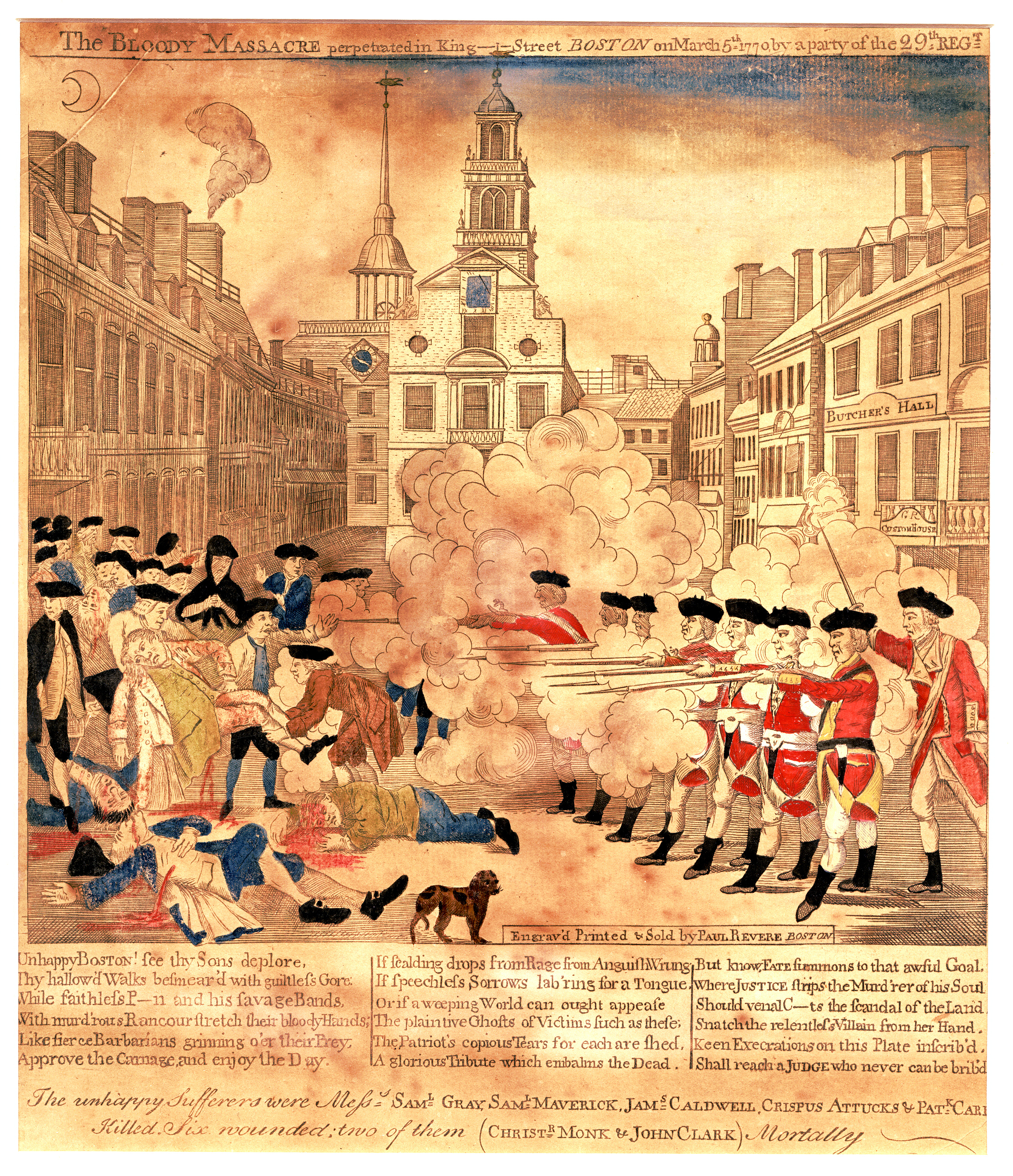
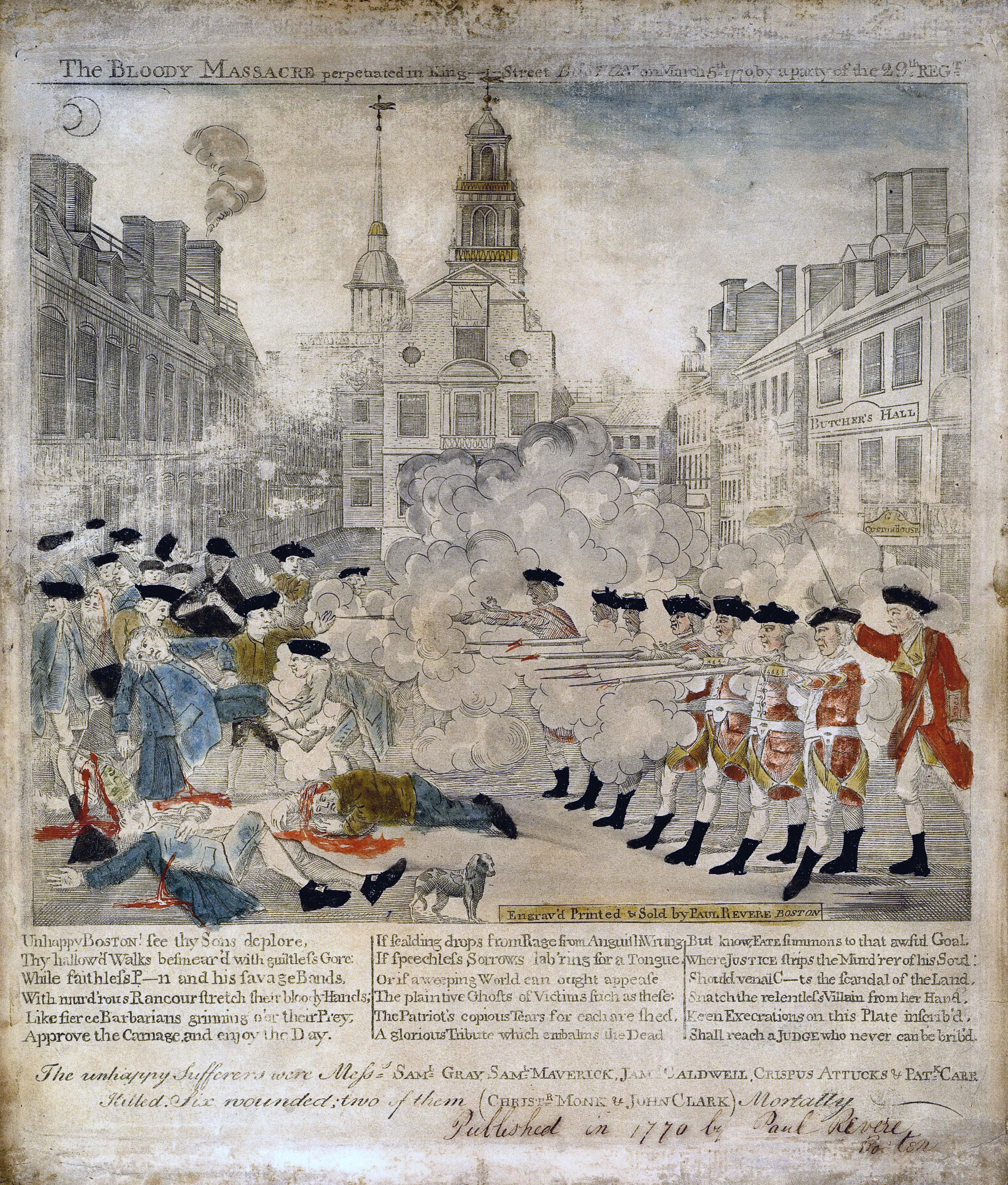
The engraving also depicts the Bostonians as unarmed, but this isn’t true. There were quite a few members of the mob who were armed, and not just with snowballs, but with clubs and rocks. Contextually, the mob had previously targeted several customs officials, including one incident of tarring and feathering. (Does this mean anyone deserved to be shot? No, and none of the victims were known to have played a role in any of those incidents.)
Still, one of the actual victims, Patrick Carr, helped testify to that the soldiers were defending themselves. Poor Carr lingered for ten days after he was shot and had plenty of time to damn the men. Instead he gave testimony to his surgeon, Dr. John Jeffries, that he believed the soldiers had good reason to fear for their live. Jeffries was allowed to repeat it during the trial:
I asked him whether he thought the soldiers would fire? He told me he thought the soldiers would have fired long before. I then asked him whether he thought the soldiers were abused a great deal, after they went down there? He said, he thought they were. I asked him whether he thought the soldiers would have been hurt, if they had not fired? He said he really thought they would, for he heard many voices cry out, kill them. I asked him then, meaning to close all, whether he thought they fired in self defence, or on purpose to destroy the people? He said, he really thought they did fire to defend themselves; that he did not blame the man whoever he was, that shot him.
… he was a native of Ireland, that he had frequently seen mobs, and soldiers called upon to quell them: whenever he mentioned that, he always called himself a fool, that he might have known better, that he had seen soldiers often fire on the people in Ireland, but had never seen them bear half so much before they fired in his life.
The day before Carr died, he told Dr. Jeffries that:
he forgave the man whoever he was that shot him, he was satisfied he had no malice, but fired to defend himself.
Samuel Adams then publicly dismissed Carr’s testimony on the basis of him being Irish and therefore probably Catholic, which clearly invalidated everything Carr said (sarcasm here).
That the soldiers were also Irish was used against them in public, too, because of the assumption that the Irish were all Catholic. However, none of the soldiers were, as the British Army actually didn’t allow Catholics to serve in the military until 1778. But that didn’t matter, because evil Irish Catholics slaughtering liberty-loving Protestants fit the preferred narrative.
Another note: the defense actually also used the term “Irish teagues” to insult the mob, so despite their best witness and victim being Irish, and the defendants largely being Irish themselves, the Irish still caught strays.
Positioning of the Soldiers
Unlike in this engraving, the soldiers were not in an orderly line firing at calm civilians. By the time shots rang out, the soldiers were in a semicircle and quite literally surrounded. One of them had just been knocked down.
In the end, seven soldiers were acquitted: Captain Preston in the first trial, and then six of the defendants in the second trial of the eight rank and file soldiers.
Two defendants were convicted of the lesser charge of manslaughter, including Matthew Kilroy. Manslaughter technically could invoke the death penalty, but in practice the sentence was a branding on the thumb so long as the convicted could recite a Bible verse (Psalm 51:1, usually) and thus plead “benefit of clergy.” They did so and received the brand.
Later in life, and after his presidency, John Adams said that he:
never pitied any men more than the two soldiers who were sentenced to be branded in the hand for manslaughter. They were noble, fine-looking men; protested they had done nothing contrary to their duty as soldiers; and, when the sheriff approached to perform his office, they burst into tears.
Did They Fire from the Windows?
In the engraving, customs officials are depicted as firing from the windows of the custom’s house. That was proven in court to not have happened… during the third Massacre trial, which was for four customs officials.
Yes, a third trial. Almost no one discusses it. These poor customs officials were acquitted because the only evidence against them was the testimony of a fourteen-year-old indentured servant boy named Charles Bourgatte–and one of the men he accused was his master.
Bourgatte allegedly admitted he’d made it all up to a third party–partly to get better food, and partly because he was very afraid of one of the frequent instigators of mob attacks (William Molineux), who encouraged him to make such claims. Molineux denied this, but let’s just say that Molineux was known to be someone for whom pressuring and even threatening a scared kid, even if he only ever said to tell the truth (as he claimed), would not be out of character.
Anyways, then there was a fourth trial. Bourgatte, who, as an indentured servant, was essentially a temporary slave, and also a foreigner by the way (French), was tried for perjury on March 8, 1771. He was convicted and sentenced to 20 or 25 lashes in public. Apparently on the first attempt to whip him, the mob had a broken clock moment and did a good even if for sketchy reasons and prevented the whipping. However, it was eventually carried out:

A Tory newspaper wrote that:
It is advised to be remembered that the Boy in Excuse for himself offered nothing, but that he was advised to it, by a Man who treated him well, and promised him he should not suffer for it.
(Though unnamed, they’re pretty clearly implicating Molineux.)
No one likes to remember this nowadays. Firstly, a case proceeding to trial based only on one person’s word makes a mockery of the judicial process (yes, even in those days). It also switches the narrative so that the colonists are enacting injustice. Secondly, despite being normal for the times, no one really wants to remember or take responsibility for the side of freedom and liberty and justice publicly torturing and humiliating a child who was already disenfranchised and literally owned by someone else… especially when everyone involved knew even at the time that this child was being exploited by adults with no regard for his wellbeing.
The Narrative
The narrative that was stirred up around the event has almost overshadowed the actual reality of that event. Which is understandable to a degree, but also just not historically accurate. Said historical inaccuracies also perpetuate myths about real people who really suffered. We already discussed a lot of this in our previous post, but we’ll go a little deeper here.
Were the Massacre Victims the First Martyrs of the American Revolution?
While Boston Massacre gets held up as a turning point in the road to Revolution, and it certainly was, it wasn’t actually the first time a mob incident in Boston led to shots killing an innocent person.
Only a few weeks prior, in February 1770, ten-year-old Christopher Seider was killed when a mob surrounded the house of a customs official. Said official, Ebenezer Richardson, was arrested and convicted for this, but later pardoned (and, in short, his trial was a complete disaster for everyone).
Seider, who was also a servant despite his young age due to his family being impoverished immigrants from Germany, was given a grand funeral. Donations were made to create a permanent monument, because the townspeople wanted to honor this poor boy whom they saw as a martyr. Supposedly.
The memorial was never built.
Who Killed the Victims?
The trial proved that two soldiers definitively killed two of the victims: Montgomery shot Attucks, and Matthew Kilroy killed Samuel Gray. However, it’s worth noting that the indictments for murder actually named Kilroy as killing Samuel Maverick, James Hartigan as killing Gray, and William Warren as having killed Attucks (along with John Carroll for James Caldwell and Hugh White for Carr). So basically, until the trial allowed facts to come out, the reports and even legal records were based more on hearsay than fact. Though this isn’t surprising, given that firearm forensics didn’t exist then. Still, they could determine that one of the weapons was never fired, and thus aside from Kilroy and Montgomery, none of the soldiers could be proved to have killed anyone… which probably greatly aided their legal case.
Historians generally conclude that the man who didn’t fire was most likely Corporal Wemys, but it can’t be known for certain.
Were the Soldiers Acting Out of Malice?
To be fair, this is kind of impossible to prove either way. We never know what’s in someone’s heart.
While it doesn’t excuse murder, it’s worth nothing that while prison awaiting trial, four of the soldiers, along with Ebenezer Richardson, had their names added to a petition offering to back up the accusations of a Bostonian woman who was viciously assaulted by the gaolkeeper while visiting her husband (he was in gaol for armed robbery – that will get its own post). There was no benefit to them doing this other than justice (especially since the gaolkeeper could abuse his authority over them), and for that I’ll give them credit.
The public narrative in the immediate aftermath of the Massacre also singled out Matthew Kilroy, who, alongside Montgomery (the other proven to have shot someone that night), would be one of two soldiers convicted of manslaughter. The newspapers and prosecutors absolutely tore Kilroy apart.
Kilroy was twenty-two and had been in the army since he was fifteen–quite literally a child soldier. He was much younger than the majority of his regiment (on average, they were in their 30s), illiterate, and, as mentioned above, Irish. There were a few specific reasons for Kilroy being singled out. The problem is none of them held up in court.
Firstly, Kilroy’s bayonet was the only one with blood all over it after the event. This led to the widespread rumor that he’d stabbed it into Samuel Gray’s brains after shooting him. In fact, even in famous renditions of the Massacre, precisely this is depicted. The problem is, that’s almost certainly not true. While one witness claimed he saw Kilroy do this, another witness (who was right in front of Kilroy and narrowly missed being hit by the bullet that took Samuel Gray’s life) not only refuted this fact, but said Kilroy wasn’t even aiming at anyone.
Furthermore, during the trial, a third witness testified that he had run at the soldiers while wielding a “stick” and gotten sliced by a bayonet. So while it’s impossible to completely rule out that another soldier wiped their bayonet clean, it’s unlikely they had time to do that, and it seems extremely likely this was the cause of the blood on Kilroy’s bayonet, not the desecration of a man’s body.
Another testimony given against Kilroy stated that he had once said that he would never miss a chance to fire on Bostonians. This clearly aimed to prove premeditation… the only problem was that the witness claimed that it happened 1-2 weeks before the Massacre, but then said it may have happened after a certain ropewalk brawl involving soldiers fighting Bostonians (3 days before the Massacre), and couldn’t recall if it was a joke or not. One of the judges, Trowbridge, seemed to have serious doubts about the witness’s honesty:
… it would be extreme hard to connect such discourse with this transaction, especially as Kilroy’s being at the customs house was by order of his officer, not voluntary. Hemmingway says he cannot remember what words preceded or followed, or at what particular time the words were uttered, nor does he know whether Killroy [sic] was jocular. If the witness is not mistaken, the speech was at least, very imprudent and foolish. However, even if Kilroy uttered those words, the assault upon him may be such as to justify his firing and killing, or alleviate it so as to make it but manslaughter.
Kilroy may not have been above reproach in behavior (he participated in that brawl a few days prior to the Massacre), but as the judge says above, that wasn’t necessarily relevant to his legal case.
Still, his reputation was in tatters. After the conviction of Kilroy and Hugh Montgomery for manslaughter, there was an application made to pardon Montgomery from branding, because people generally thought well of him. Plus, he had been proven to have been knocked down before shooting, and thus to have fired in self-defense (keep in mind that an armed mob of several hundred knocking someone over would certainly seem like a dangerous situation). Kilroy, not so much.
The problem is that, of the two convicted, Kilroy, the one everyone held up as a true example of just how malicious the British soldiers were, was actually not the one who instigated the bloodshed that night.
Fire!
The soldiers insisted they were obeying orders. Now, that’s not a moral defense by any means, ever. The soldiers argued in their defense that soldiers who refused to obey orders could be executed for this in the British Army, which was true. That still doesn’t address the morality, but does provide context.
Morality and the law don’t always go hand-in-hand, though. Legally, the problem was whether there were orders, or not. Captain Preston insisted he did not order them to fire, so the question became whether or not he was lying, or if they were… or, as Preston suggested, in the chaos one of them heard someone, maybe a soldier or maybe a mob member, say “fire,” and mistakenly attributed it to Preston.
As it turns out, Preston was right. None of the soldiers were lying about “fire,” save one by omission.
After Montgomery’s and Kilroy’s conviction for manslaughter, Montgomery confessed to a third attorney that he had indeed said “damn you, fire” after being knocked down. Thus, the other soldiers almost certainly did really hear someone say “fire,” but in the chaos didn’t realize who had spoken.
Had the townspeople known this, it’s possible they would have shifted their target from Kilroy to Montgomery, but a married father of three made for a more complicated target than the uneducated, unattached, and unimportant Kilroy.
All this to say, there are many complexities to the Massacre, none of which erase the tragedy of five dead (really six – Christopher Monk would die from complications from his wounds ten years later). But we do the real life people who were involved a disservice when we negate the messy humanity of everyone involved for an easier narrative.
Leave a Reply